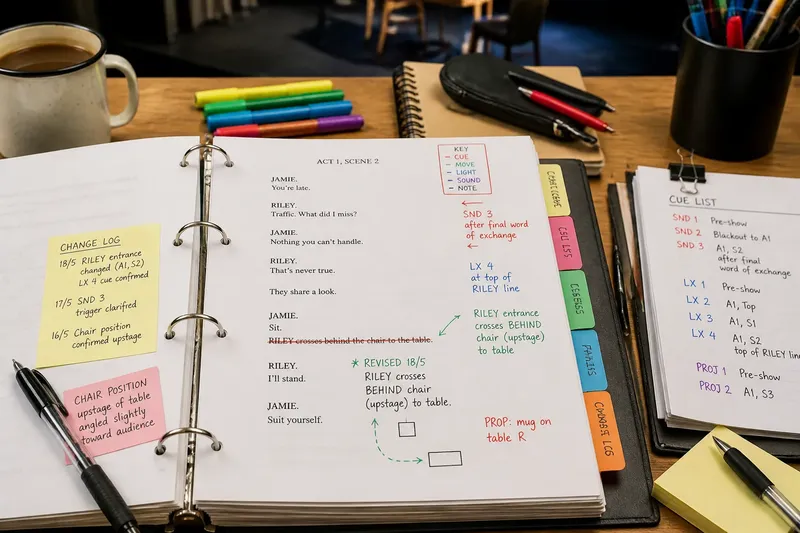
The Prop Table Is Not a Storage Shelf
A prop table for rehearsal gives every hand prop a clear home, helping actors make confident handovers and keeping scene transitions calm and readable.
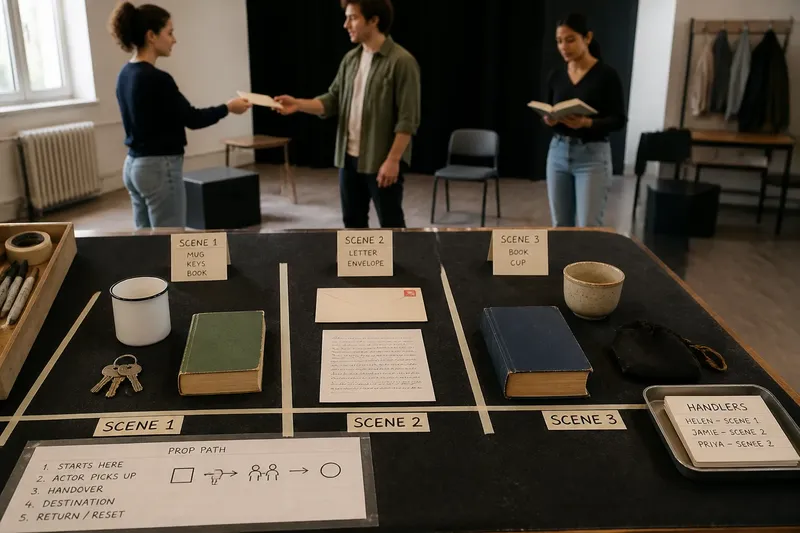
The most common prop-table mistake is treating it as a place to park spare objects; the cost is a cast that cannot tell which cup, letter, or key belongs to the next entrance. A prop table for rehearsal works best as a small map of the show’s hand props, not a convenient shelf for everything the room has accumulated.
That distinction matters most when objects move between actors or scenes. A clear home lets a performer check an item at a glance, return it without asking, and leave the next person’s entrance undisturbed. The table does not need to look polished. It needs to make the next action obvious.
What belongs on the prop table?
Keep objects actors handle during the performance on the table or in a clearly assigned nearby place. Common examples include letters, hand-held books, cups, keys, small bags, and items that are passed, opened, carried, or deliberately set down.
Not every object used in a scene belongs there. A chair, a large scenic piece, or a coat worn throughout a scene may have a better home in the playing area or costume space. The useful question is not “Could this object be a prop?” but “Does an actor need to find, hand over, or reset it as part of the action?”
Separate performance props from personal belongings and general rehearsal supplies. A water bottle, phone, pencil case, and spare roll of tape may all be welcome in the room, but mixing them with show items makes the table’s purpose harder to read. Give those things a different surface or bag.
How should the table be arranged?
Arrange the surface so each item has a visible, repeatable place. A piece of masking tape can mark a spot, while a simple paper label can identify an item or the scene in which it is used. Leave enough space that one object can be lifted without shifting several others.
Group props by the way the show uses them. For a short play with a few scenes, separate areas labeled by scene may be easy to scan. For a busy sequence of handovers, grouping by actor or entrance can be clearer. Choose the arrangement that answers the performer’s real question fastest: “Where is my object now?”
Keep especially similar items apart. If two scenes use different envelopes, mark each one discreetly and place them in separate spots. If an actor needs a particular side of a table for a pickup, keep that route open rather than filling the edge with unrelated objects. The layout should support movement as well as storage.
Who resets each prop?
Assign each item a clear handler or reset responsibility. The actor who carries a prop may be the natural person to return it, but a handover can make another actor the next handler. Make that change explicit during rehearsal, so the object does not become everyone’s responsibility and therefore no one’s.
Trace each prop’s path in plain language: where it starts, who takes it, where it goes, and who returns it. This is especially helpful when an object is set down somewhere other than the prop table. The cast should know whether the next scene begins with the item on a chair, in a pocket, or back at its marked place.
A named stage manager or rehearsal leader can keep the arrangement consistent, but that does not mean one person must personally reset every object. The practical goal is shared clarity. If the person responsible is absent, another cast member should be able to understand the system without guessing.
How do props clarify handovers?
A handover is part of the scene’s action, not just an exchange of objects. Rehearse who offers the prop, who accepts it, where both actors look, and what happens immediately afterward. A pause to search for a letter can drain energy from a moment; a confident exchange lets attention stay on the characters.
Give an object a consistent destination after the exchange. An actor might place a key in a bowl, return a book to a marked shelf, or carry a cup offstage. If the item is meant to return to the table, rehearse the route and the moment of return rather than relying on memory at the end of a scene.
Imagine a small cast rehearsing a scene in which one character gives another a note, then the recipient exits with it. They decide the note begins at the marked left corner, the first actor picks it up on a cue, and the recipient keeps it through the exit. The expected observable result is a clear exchange and an empty starting spot ready for the next scene, rather than a note left behind for someone to discover.
What should happen between scenes?
Make the reset part of the transition plan. Decide which objects stay in the playing area, which travel with an actor, and which return to the table. When the cast knows the sequence, a scene change feels like a coordinated beat rather than a scramble for missing items.
For a quick transition, use a short verbal or visual cue that tells the reset crew when to move. Avoid placing a prop where it blocks a doorway, an actor’s route, or the next scene’s first action. If an object must be carried across the stage, let that movement serve the transition rather than sending someone back and forth without purpose.
At the end of a run-through, take a moment to restore the table before moving on. This is not a ritual for its own sake: it gives the cast a known starting point for the next rehearsal pass and makes a missing item easier to notice while the last scene is still fresh in everyone’s mind.
What labels and materials help?
Use supplies that are easy to remove and unlikely to damage the venue’s furniture. Masking tape, index cards, a marker, and shallow trays can be enough for a modest rehearsal setup. If the surface is shared, a labeled cloth or portable board can define the working area without permanently marking anything.
Write labels for quick recognition, not decoration. A useful card might say “Scene two: keys” or “Mara: letter,” depending on how the cast searches for the item. For an object with a particular orientation or placement, a small drawn outline can show where it sits; avoid detailed diagrams that take longer to interpret than the prop itself.
Check the item’s handling requirements and any venue rules before choosing a substitute or attaching a label; follow the manufacturer’s instructions where relevant. For an item that could be mistaken for something hazardous, ask the director or stage manager to settle a safe, clearly communicated arrangement.
What is not worth organizing?
Do not spend rehearsal time building a miniature warehouse system for a handful of objects. Color-coded inventories, elaborate sign-out forms, and decorative labels are not useful if the cast still cannot see where the next prop goes. Start with visible homes and a clear person responsible; add complexity only when a recurring confusion calls for it.
Likewise, perfect symmetry is not the goal. The table can look lived-in as long as each item has a known place and unrelated belongings stay elsewhere. A quick reset that everyone understands is more valuable than a beautiful arrangement only one person can maintain.
Which prop-table questions come up?
Should actors take props from the table?
Yes, if that is the agreed starting point for the scene. Rehearse the pickup and the return or exit route so the table remains ready for the next user.
Can props stay in the rehearsal room?
They can if the room’s rules allow it and the storage place is secure and clearly separate from everyday items. If the room is shared, take valuable or delicate items with you rather than leaving them on an open surface.
What if a prop goes missing?
Check its last assigned location and ask the person who handled it last, without turning the search into a blame session. Once found, update the route or responsibility if the confusion came from an unclear reset.
How can a table work in a small room?
Use a compact tray, folding table, or labeled section of a stable surface, provided it stays out of traffic. Keep the most frequently handled items easiest to reach and put less-used pieces in a separate, identified container.
A prop table for rehearsal earns its space by making the next move legible: the actor can see what is theirs, the handover has a destination, and the transition leaves the room ready for the scene ahead. Keep the arrangement simple enough that a new cast member can understand it at a glance, then let the work onstage carry the audience’s attention.