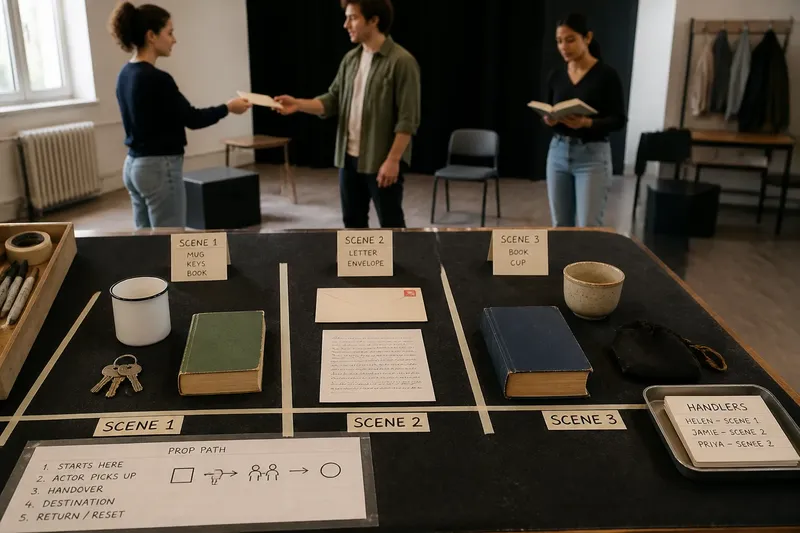
Before the Rehearsal Room: The Prompt Book Takes Shape
A prompt book keeps cues, blocking decisions, and production notes in one usable record, so the team can find the current answer without chasing scraps.
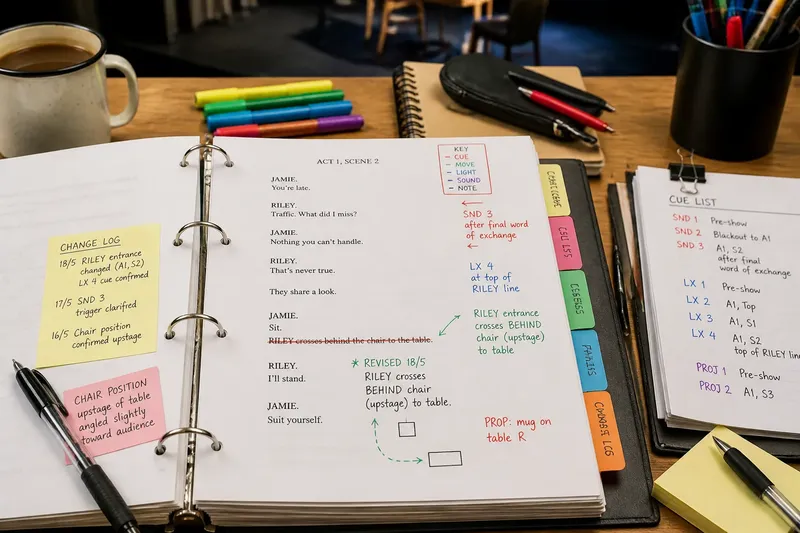
The common mistake with a prompt book is waiting until rehearsal is underway to start one. Then blocking lives in a margin, a sound cue in someone’s phone, and the latest change in a message thread; the cost is time spent reconciling versions instead of making the next decision. A prompt book is easier to use when its shape is chosen before the room fills.
For a small amateur production, the right format depends on what the team needs to consult and who will maintain it. Think of the book as a working record, not a scrapbook: it gathers decisions that affect the next person’s task and makes their current status clear.
Choose the format
If one person is calling cues from a script, a paper prompt book is often the most direct choice. Use a clean script copy in a three-ring binder, with wide margins or separate annotation sheets. The pages stay in sequence, and a stage manager can turn to the relevant line without switching between files.
Choose a shared digital document when several people must update the same production record between rehearsals. A cloud document can hold a cue list, rehearsal notes, and links to approved plans. Give editing access to the people responsible for updates and make the current version obvious; a folder full of files named “new,” “newest,” and “final” is not a working system.
A hybrid book fits productions that need both quick access at the calling desk and easy sharing. Keep the script and cue annotations in a printed binder, while storing reference documents and the current change log in a shared folder. Decide which copy is authoritative. If a note appears in one place but not the other, the team needs a clear route for resolving it.
Decide what belongs
Include information that helps someone carry out or verify a production decision. Depending on the show, that may mean:
- Blocking notes tied to a line, beat, or clearly named moment.
- Entrance and exit reminders that affect traffic or timing.
- Lighting, sound, projection, or music cues, with a cue label and the point at which it is called.
- Scene transitions and any agreed signals between departments.
- Contact details or brief operational notes needed by the production team.
- A dated change log that says what changed and which pages or cues it affects.
Keep private or sensitive information out unless the production has a clear reason to retain it and an appropriate place to store it. A prompt book is not a diary of every rehearsal conversation. Notes such as “try a different energy” may belong in a temporary rehearsal record; if the director and actor settle on a specific playable choice, record that decision in a useful, neutral form.
Match the book to the job
If you are the person calling the show, prioritize script order and quick cue access. Mark cue points consistently, leave room for revisions, and keep the cue list aligned with the script. If you are producing a play with minimal technical cues, a compact annotated script may be enough. A large technical spreadsheet would add upkeep without helping anyone work faster.
If you are coordinating a production with multiple departments, use the book to connect their decisions rather than duplicate every department’s paperwork. The prompt book can point to the approved lighting plan or sound file and state which version is in use. The lighting operator still needs the actual lighting paperwork; the prompt book should help the team locate it, not pretend to replace it.
If the director is still exploring blocking, record only choices the cast should repeat or the team must accommodate. Mark tentative notes as tentative, then confirm or remove them when the choice settles. Otherwise, an early idea can look like an instruction simply because it was written down.
Build a clear page
Use a consistent marking system that remains legible under ordinary rehearsal-room conditions. For example, reserve one color for cues and another for movement, and write a short key at the front. Avoid a rainbow of marks whose meaning only one person remembers. Pencil is useful for decisions likely to change; permanent ink suits confirmed information that should not be casually overwritten.
Say you are stage managing a short play in a binder, and the cast changes an entrance so a performer crosses behind a chair instead of in front. Write the new path beside the relevant line, add a brief note about the chair’s position if that affects the crossing, then remove or cross out the superseded direction. The expected result is a page that tells the cast and stage manager which version to repeat, without requiring them to interpret two conflicting arrows.
For cues, pair a clear identifier with a precise verbal or textual trigger. “Sound 3, after the final word of the exchange” is more usable than “music here.” The exact wording depends on the production’s cue convention, but the purpose stays the same: the person calling and the person executing the cue should be able to find the same moment.
Keep the record current
Choose one person to maintain the master copy, even if several people can suggest edits. At the end of a rehearsal, gather confirmed changes, update the record, and make the revised copy available before the next call. If a change remains undecided, label it accordingly rather than letting it blend into settled information.
At a run-through, use the book as a reference, not a substitute for attention. Note where a cue was missed or a transition became unclear, then discuss what needs changing. A clean record can reveal a mismatch between the written plan and what the team is actually doing; it cannot make the artistic decision for them.
Which setup fits?
Do I need a separate prompt book?
Not necessarily. For a simple production with one caller and few technical cues, an annotated script may cover the job. Use a separate binder or file when the record needs cue lists, plans, and change history that would crowd the script.
Should actors write in the master copy?
Usually, keep the master controlled by the person maintaining it and let actors keep their own rehearsal notes. Invite proposed changes, then enter the agreed version once, so the working record does not acquire competing edits.
What if blocking changes often?
Mark unsettled choices as provisional and use erasable notes or a separate temporary sheet. Once the director confirms a choice, transfer it to the master and remove the outdated instruction.
How much detail is too much?
Include detail when another person needs it to repeat a cue, movement, or transition consistently. Leave out commentary that does not guide action or preserve a decision; it makes the useful notes harder to find.
Skip the ornament
Decorative covers, elaborate color systems, and painstaking transcripts of every rehearsal exchange are rarely worth the effort. Spend that attention on readable pages, stable labels, and removing contradictions. Those choices make the prompt book useful when someone needs an answer quickly.
Before opening night, the prompt book should tell the team what has been decided, where to find supporting material, and which notes are still in progress. A well-kept prompt book does not need to look impressive; it needs to make the current production legible to the people carrying it forward.